The best time to trade EUR/USD is when London and New York are both open: from 15:00 to 18:00 server time (8:00 to 11:00 in New York), EUR/USD moves on average 24 to 26 pips per hour, almost three times more than in the quiet hours after the US close. The London open, at 10:00 server time, is the second most active moment. Spreads are lowest during those same hours, so costs weigh least when the market moves most.
These figures come from 71,540 hours of EUR/USD 1-minute data, from January 2015 to July 2026.
How much EUR/USD moves in each hour
For every hour of the day we measured the range, the distance between the highest and the lowest price within the hour, then averaged it over eleven years.
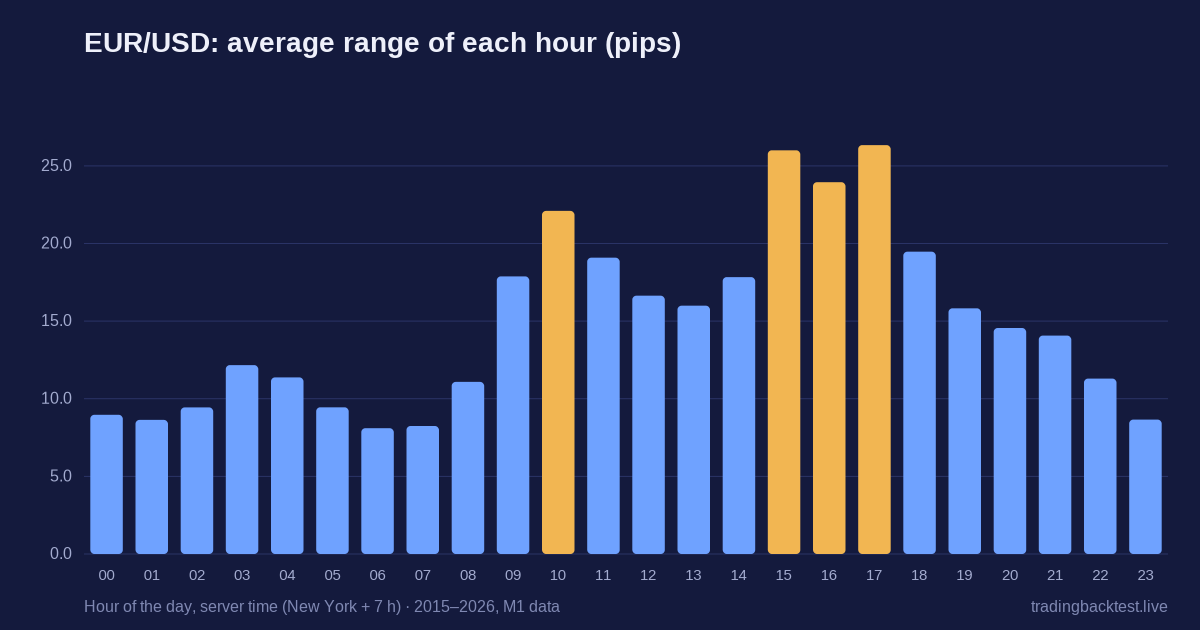
EUR/USD, 1-minute data from 2 January 2015 to 9 July 2026. Hours in server time (New York + 7 h). Amber bars: the four most active hours.
| Hour (server time) | Average range (pips) | What happens |
|---|---|---|
| 01:00 to 08:00 | 8 to 12 | Asian session: Tokyo and Sydney trade, EUR/USD is quiet |
| 09:00 | 17.9 | Frankfurt opens |
| 10:00 | 22.1 | London opens |
| 11:00 to 14:00 | 16 to 19 | European morning |
| 15:00 | 26.0 | US economic data at 8:30 New York |
| 16:00 | 23.9 | US stock market opens at 9:30 New York |
| 17:00 | 26.3 | US data at 10:00 New York, peak of the London–New York overlap |
| 18:00 | 19.5 | London fix and close of European markets |
| 19:00 to 22:00 | 11 to 16 | New York afternoon |
| 23:00 to 00:00 | 8 to 9 | Close of the trading day, rollover |
Two things stand out:
- The overlap is the busiest period. Each hour from 15:00 to 18:00 moves about three times more than an hour of the Asian session.
- The quiet hours are very quiet. Between 06:00 and 08:00, EUR/USD moves about 8 pips per hour. A strategy with a 10-pip target trading at that time needs more than an hour of normal movement just to reach it.
Spreads by hour
A wider spread makes every trade more expensive. We took the median spread recorded in the same data for each hour.
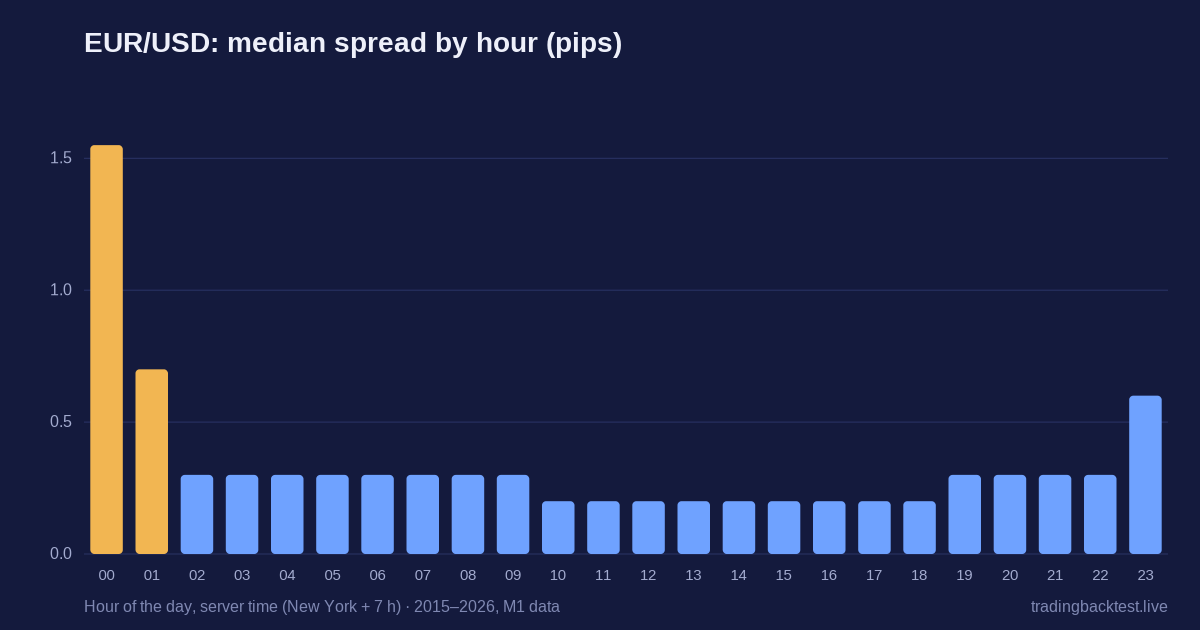
Median spread in the same 1-minute data, a raw-spread account: your broker’s commission comes on top.
The spread stays at 0.2 to 0.3 pips most of the day, then jumps around midnight server time: 1.6 pips at 00:00 and 0.6 to 0.7 pips just before and after. That is the daily rollover, when liquidity providers reset their books.
The useful comparison is the spread as a share of what the market moves:
| Hour (server time) | Range (pips) | Spread (pips) | Spread as % of the range |
|---|---|---|---|
| 00:00 | 9.0 | 1.6 | 17% |
| 01:00 | 8.6 | 0.7 | 8% |
| 06:00 | 8.1 | 0.3 | 4% |
| 10:00 | 22.1 | 0.2 | 1% |
| 15:00 | 26.0 | 0.2 | 1% |
| 17:00 | 26.3 | 0.2 | 1% |
At midnight the spread eats about a sixth of a typical hour’s movement. During the overlap it is about one percent.
By day of the week
| Day | Average hourly range (pips) |
|---|---|
| Monday | 14.1 |
| Tuesday | 14.4 |
| Wednesday | 15.1 |
| Thursday | 15.8 |
| Friday | 15.1 |
Monday is the quietest day and Thursday the most active, but the difference between days is small compared with the difference between hours. The hour matters much more than the day.
Volatility changes from year to year
The average hourly range was 22.1 pips in 2015, 10.0 pips in 2019, 18.9 pips in 2022 and 12.8 pips in 2026 so far. A strategy tested on a single year can look very different in a calmer or a busier one: test on several years, and use stops and targets in multiples of the ATR rather than fixed pips so they follow volatility.
What this means for your strategy
- Breakout strategies need movement: restrict them to 10:00–12:00 and 15:00–18:00 server time with a session filter.
- Range and mean-reversion strategies can prefer the quiet Asian hours, but check that the target is realistic for an 8 to 12 pip hour.
- Avoid opening trades around midnight server time: the spread is several times wider and the market barely moves.
- Scalping is only viable in the active hours, when the spread is a tiny part of the movement.
You can check all of this on your own idea: add a session filter in the block builder, run the test once with it and once without, and compare.
FAQ
What is the best time to trade EUR/USD?
Between 15:00 and 18:00 server time (8:00 to 11:00 New York), when London and New York are both open. EUR/USD moves 24 to 26 pips per hour on average then, and spreads are at their lowest.
What time does the London session open in server time?
The London open is at 10:00 server time (New York + 7 hours) for most of the year, and at 09:00 during the few weeks when Europe and the US have not changed their clocks on the same day.
When is the EUR/USD spread the widest?
Around midnight server time, during the daily rollover: the median spread in our data reaches 1.6 pips at 00:00, against 0.2 to 0.3 pips during the rest of the day.
Which day of the week is EUR/USD most volatile?
Thursday, with an average hourly range of 15.8 pips, and Monday is the quietest with 14.1 pips. The hour of the day changes volatility far more than the day of the week.